
Brown County VINELink Coverage
Ohio uses VINE, VINELink, and the VINEmobile app for custody information and notifications. Official state material describes coverage for Ohio county jails, the Ohio Department of Rehabilitation and Correction, and the Ohio Department of Youth Services. The Brown County Sheriff's victim-rights material describes a statewide electronic link among county courts, county jails, state prisons, and juvenile facilities.
That local statement supports using VINELink as a Brown County search and alert channel. It does not establish a dated, separate county vendor contract. The reporting agency shown in a live result remains the key fact. For an adult at Brown County Jail, read the jail agency. For a person in state prison, read the ODRC institution and state record.
VINE is designed for a named-person check, not a recent-release list. It can report general release, transfer, escape, or death events for county-jail subjects. ODRC events can also include prison transfers, parole-hearing notices, parole revocation with return to prison, release from parole, and certain program reviews.
| Custody system | Ohio VINE role | Separate confirmation |
|---|---|---|
| Brown County Jail | Specific-person custody status and event notice | Brown County Sheriff's Office and jail records |
| ODRC prison | Custody, prison transfer, release, and selected parole events | ODRC Offender Search and Parole/Release Detail |
| ODYS | Youth custody events through restricted identifying routes | ODYS using the permitted ID and contact channel |
| Federal custody | Not covered by VINELink | BOP, USMS, or ICE source as applicable |
Search Brown County VINELink Records
Use enough information to distinguish the intended person from others with a similar name. VINELink availability and accepted fields can change by screen and agency. Enter only the details the live Ohio form requests. Then compare the identity information, agency, and facility before opening or acting on a record.
- Open VINELink and choose Ohio as the state.
- Select the offender or custody search. Enter the person's name or an accepted identifier.
- Review all possible matches. Compare the details shown rather than selecting by name alone.
- Open the matching record and note the custody status, reporting agency, facility, and last update.
- If no match appears, try a verified spelling or identifier, then check the jail or ODRC source that should hold the record.
The national VINELink search and registration screen provides the current Ohio entry point.
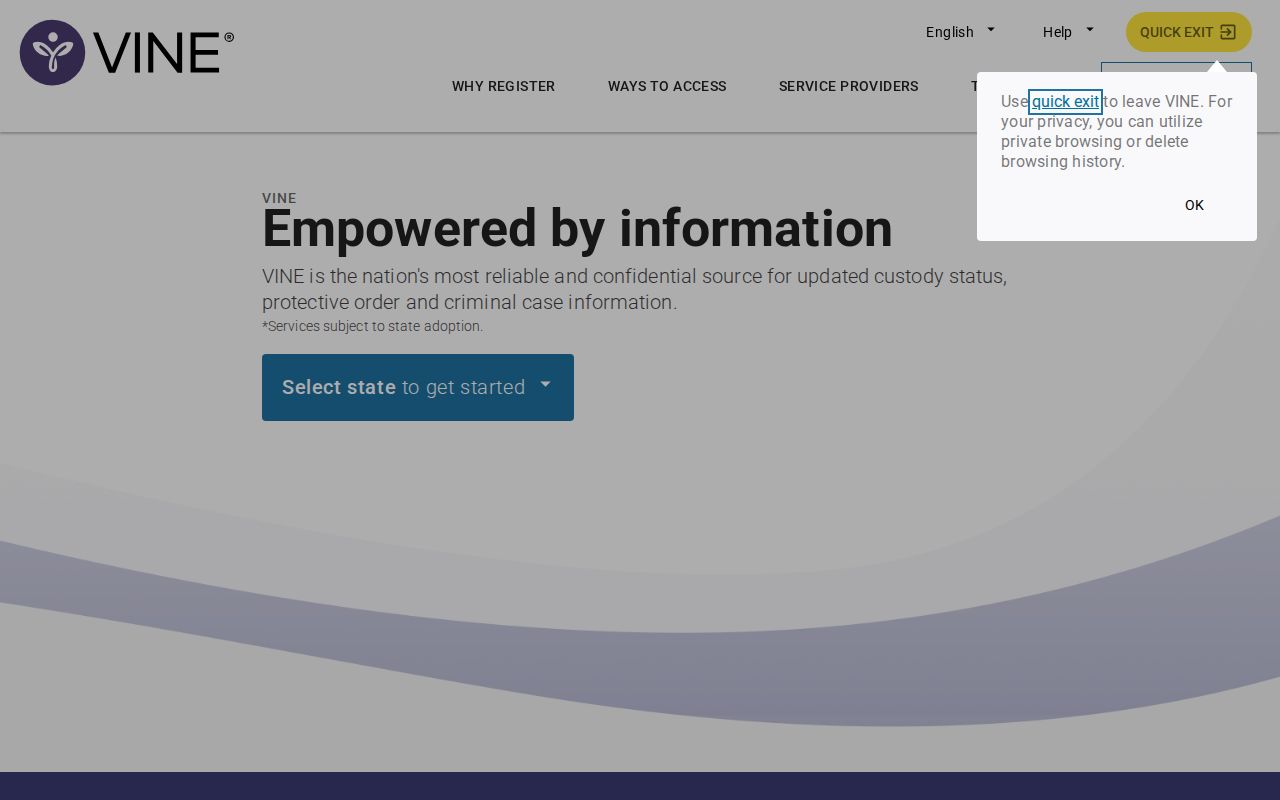
The live screen should control the exact status wording. Do not substitute an assumed label when the record uses another term.
A no-result outcome is inconclusive. The name may differ, an agency feed may lag, or the person may be in a system outside VINE. The Brown County released inmate search gives the full path through jail, court, ODRC, federal, and records-request sources when a VINELink search alone does not resolve custody.
Brown County VINELink Release Fields
The exact fields vary by reporting agency and live result. Treat the record as a custody-status message, not a full discharge record. Capture the words displayed, the agency that sent them, and the time of the latest update. A general release alert means the reporting custodian changed the person's status. It may not identify the final destination.
| Field | What to read | Limit |
|---|---|---|
| Identity | Name and available matching details | Similar names require careful comparison |
| Custody status | The current label supplied by the agency | Status can lag the physical event |
| Agency or facility | The custodian reporting the record | Another custodian may take over after transfer |
| Identifier | An agency or offender number when shown | One system's number may not work in another |
| Event | Release, transfer, escape, death, or another supported change | An alert is not a complete court or release record |
| Update time | When VINE last received or displayed data | It is not always the event time |
For an ODRC subject, compare VINE with the ODRC Offender Search. ODRC detail can show status, committing county, prison information, and Parole/Release Detail. A projected date is not actual release proof. Current state status and release detail together provide the stronger state-prison check.
Register Brown County Release Alerts
After the correct person is open, register through the notification options offered on that record. Ohio materials describe telephone, email, text, and TTY channels. Available choices depend on the current interface and event. Registration should be tied to the exact person and custodian already verified.
- Select the notification or registration option on the matching VINELink record.
- Choose the offered phone, email, text, or TTY route. Enter the requested contact information carefully.
- For a phone registration, create a four-digit PIN. It confirms receipt and helps stop repeat calls for that event.
- Complete any confirmation shown on screen. Save the offender identifier and reporting agency with the registration.
- When a call arrives, enter the PIN followed by the pound key. Without acknowledgment, calls may repeat for as long as 48 hours.
Email notices do not use the telephone PIN and are not repeated in the same way. A registration is not a guarantee of immediate contact. Networks, agency updates, and contact settings can delay delivery. Keep the direct jail or ODRC route available when timing matters.
Ohio VINE can also be reached by telephone at 1-800-770-0192 and by TTY at 1-866-847-1298. Official material describes information and representatives as available around the clock. ODRC separately maintains victim registration at 1-888-842-8464 for its state-prison system.
Brown County Victim Notification Layer
The Brown County Sheriff's Office adds a local victim-rights route beyond the national VINELink screen. Its material connects county court, county jail, state prison, and juvenile processes and points victims toward rights and notification support. This matters when a VINE event raises a court or safety question that the automated status cannot answer.
The Brown County victim-rights page is the official local gateway.
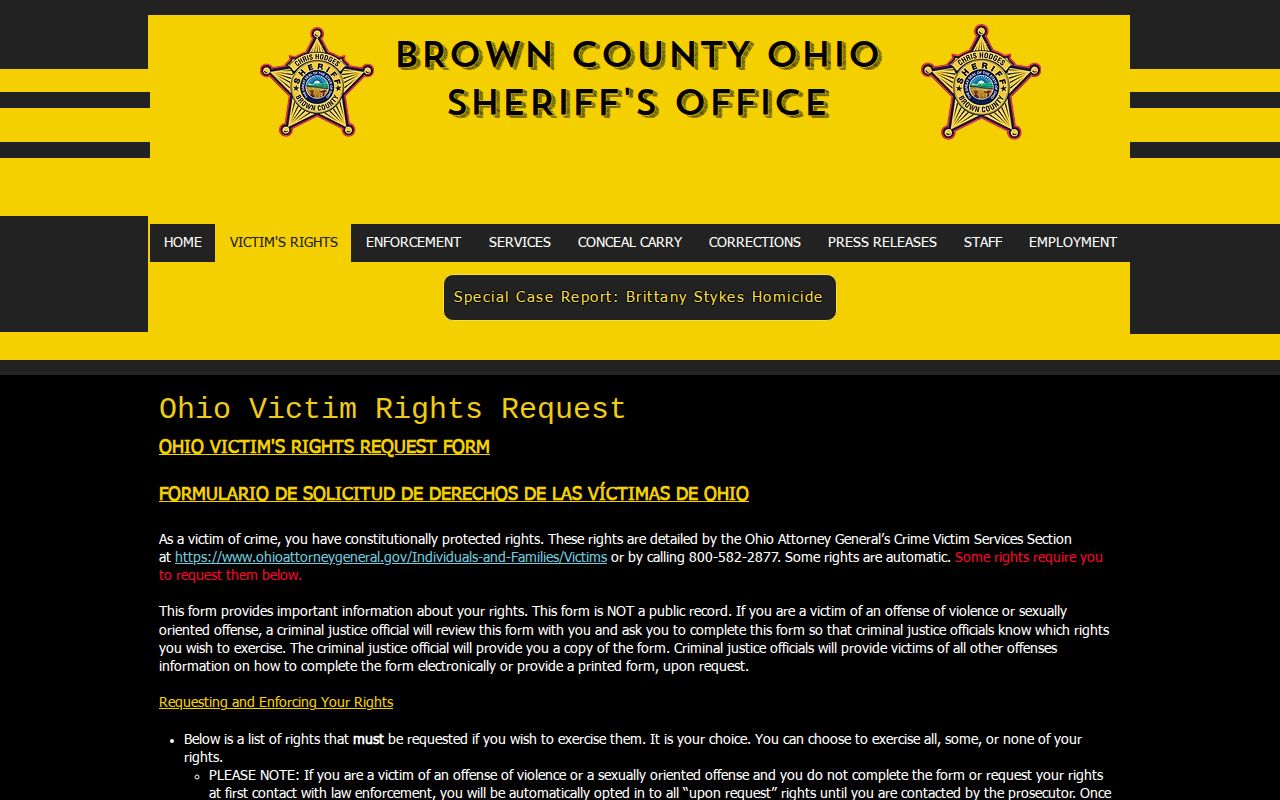
The local page supplies context and agency routing, while VINELink supplies the person-specific custody search and registration process.
Keep the two roles distinct. A victim advocate or agency can explain available rights and local contacts. VINELink automates selected custody messages. Neither replaces a court order, sheriff release record, or ODRC discharge entry.
Brown County Registry Boundary
Custody notification and offender registration answer different questions. A VINE record tracks custody status and selected events. A sex-offender registry concerns a separate legal registration duty after release. Registration status does not prove that a person remains in jail, and a VINELink result does not settle a registry duty.
The sheriff provides a Brown County sex-offender search gateway for the official registry path. It also notes a local juvenile-registration limit. Use that source only when the registry question itself is relevant.
The official gateway shows the local boundary.
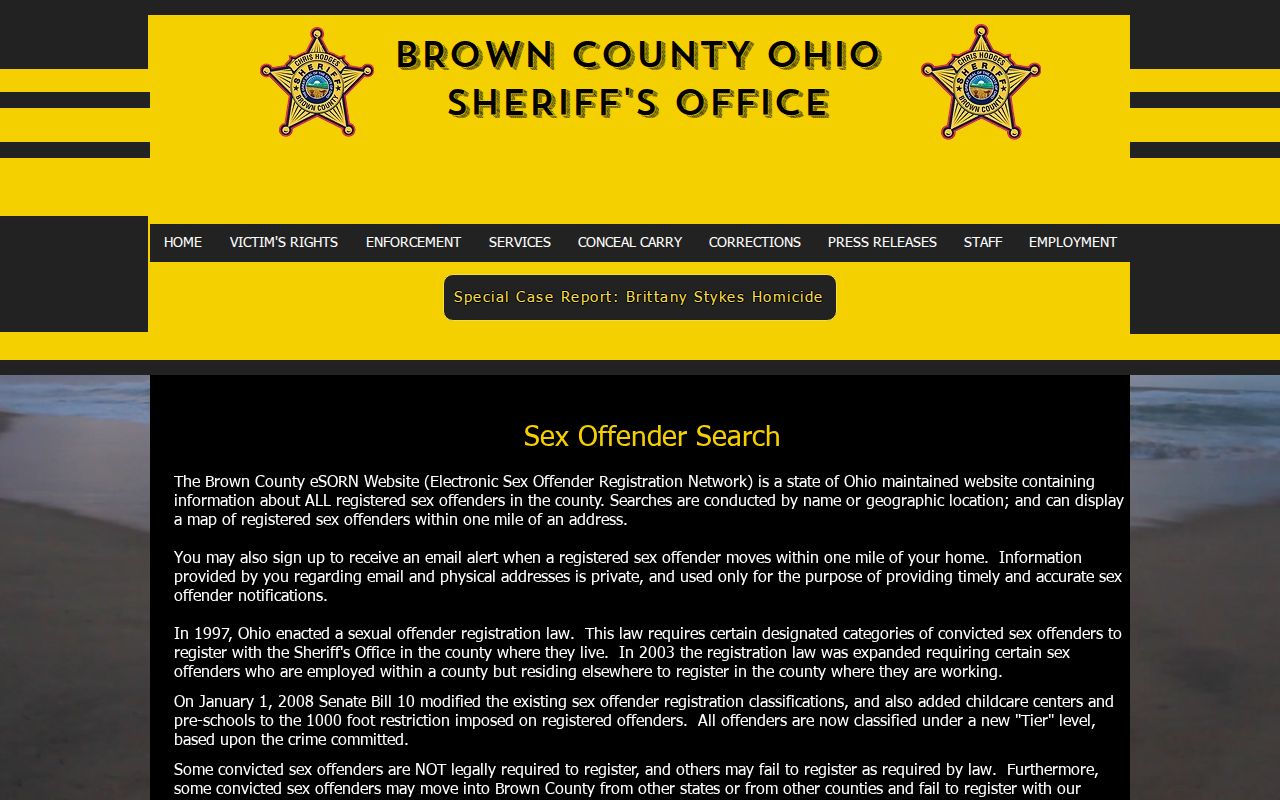
A registry match should never be substituted for a VINELink custody check or a release record.
Confirm Brown County VINELink Results
VINELink does not cover federal Bureau of Prisons custody. A Brown County federal case may involve the U.S. Marshals Service, BOP, or another contracted custodian. Use the BOP locator for people in federal prison and its released-result fields. A “Released” or “Not in BOP Custody” result means BOP custody ended, but another authority or federal supervision may still apply.
Immigration custody also uses a separate route. The ICE Online Detainee Locator has exact-match and other limits, and it can include some people released from ICE custody within the prior 60 days. A no-result is not conclusive. USMS records and court orders may be needed for a federal defendant who never entered BOP custody.
For Brown County Jail, call the jail at 937-378-4435 or seek the sheriff's release and discharge record. The live Miami Valley Jails page is explicitly for people currently in custody, so removal alone does not identify release reason or destination. For ODRC, compare the state detail record. For a court event, read the applicable Brown County docket and account for its posting delay.
Use this confirmation order: identify the reporting VINE agency, verify the same person in that agency's record, and check for a receiving custodian or court order. A custody-change alert becomes reliable release context only after those records agree.
Timing deserves special care. VINE receives information from a participating agency, so the alert cannot arrive before that agency enters and transmits the event. A phone call, text, or email may reach the registered contact after the physical move. Conversely, a court order may appear before jail staff complete the release process. Record each source's update time and avoid converting those different timestamps into one assumed release time.
A transfer is the most common source of confusion. Leaving Brown County Jail for ODRC ends county-jail custody but begins state-prison custody. A move to another county jail, ICE, or USMS custody works the same way. The first VINE event may be accurate even though the person is not free. Search the receiving system when the jail, docket, or notification identifies one.
If a notification arrives with an unexpected name, facility, or event, do not act on it as a match. Reopen the saved registration, compare the identifier, and contact VINE or the reporting agency through an official number. Similar names and reused contact details can cause mistakes. Never rely on a callback number contained only in an unverified message.
Keep a small verification record: the searched name and identifier, agency, facility, status wording, update time, alert channel, and the direct source used for confirmation. This makes it easier to explain whether the result reflected county custody, ODRC custody, or only the end of one agency's control.