
Brown County Parole and Probation
Parole and probation can both allow a person to live in the community under rules, but they come from different authorities. The ODRC Offender Search is the public route for a person committed from Brown County who later appears with an APA supervision status. The Ohio Adult Parole Authority supervises parole, post-release control, and other qualifying state releases. The Ohio Parole Board makes parole decisions for eligible prison terms.
Probation is a court sentence or part of a court order. Ohio courts often call it community control. Brown County Common Pleas handles felony matters, while Municipal Court handles its own misdemeanor and traffic cases. Neither local court role should be treated as an APA function. A jail release also does not prove that either type of supervision exists.
| Point | Parole or APA supervision | Probation or community control |
|---|---|---|
| Authority | ODRC, APA, and for parole decisions the Ohio Parole Board | Brown County Common Pleas or Municipal Court |
| Starting record | ODRC offender detail and Parole/Release Detail | Judgment, sentence, or community-control order in the court docket |
| Public check | ODRC Status filters and detail record | Court docket, followed by clerk or probation-office confirmation |
| End record | Supervision termination or final release from APA control | Court termination, discharge, or expiration entry |
- Parole
- Conditional community release for a prison sentence that remains under state authority.
- Post-release control
- A period of APA supervision that follows certain Ohio prison terms.
- Community control
- Ohio court supervision commonly called probation.
- Discharge
- An official end to custody or supervision, shown by an agency or court record.
Check Brown County Release Supervision
Begin with the court and custody path. A person sentenced to ODRC uses a state record. A person ordered to Brown County community control uses the relevant court record. When the path is uncertain, the Common Pleas record search can identify a felony judgment, while the Municipal Court record search covers that court's matters. Both court sites warn that postings may lag by at least a day or longer.
- Identify whether the sentence went to ODRC or to Brown County court community control.
- For state supervision, search ODRC by name or number. Read Status, Parole/Release Detail, supervision dates, and committing county together.
- For local probation, find the judgment or community-control order in the correct Brown County docket. Record the case number.
- Contact the clerk or probation office when current status matters. A delayed docket is supporting evidence, not a live status feed.
- Check any violation, warrant, termination, expiration, or discharge entry. Do not infer completion from elapsed time alone.
ODRC labels can be precise. “APA Supervision” means a person has left prison but remains under department supervision. “Judicial Release” means a sentencing court released the person to community supervision. A plain “Released” status needs its detail fields and court history for context. County-only jail bookings may never appear in ODRC.
The statewide search view shows why the source matters. The official ODRC search provides the status filters and detail route used for Ohio supervision checks.
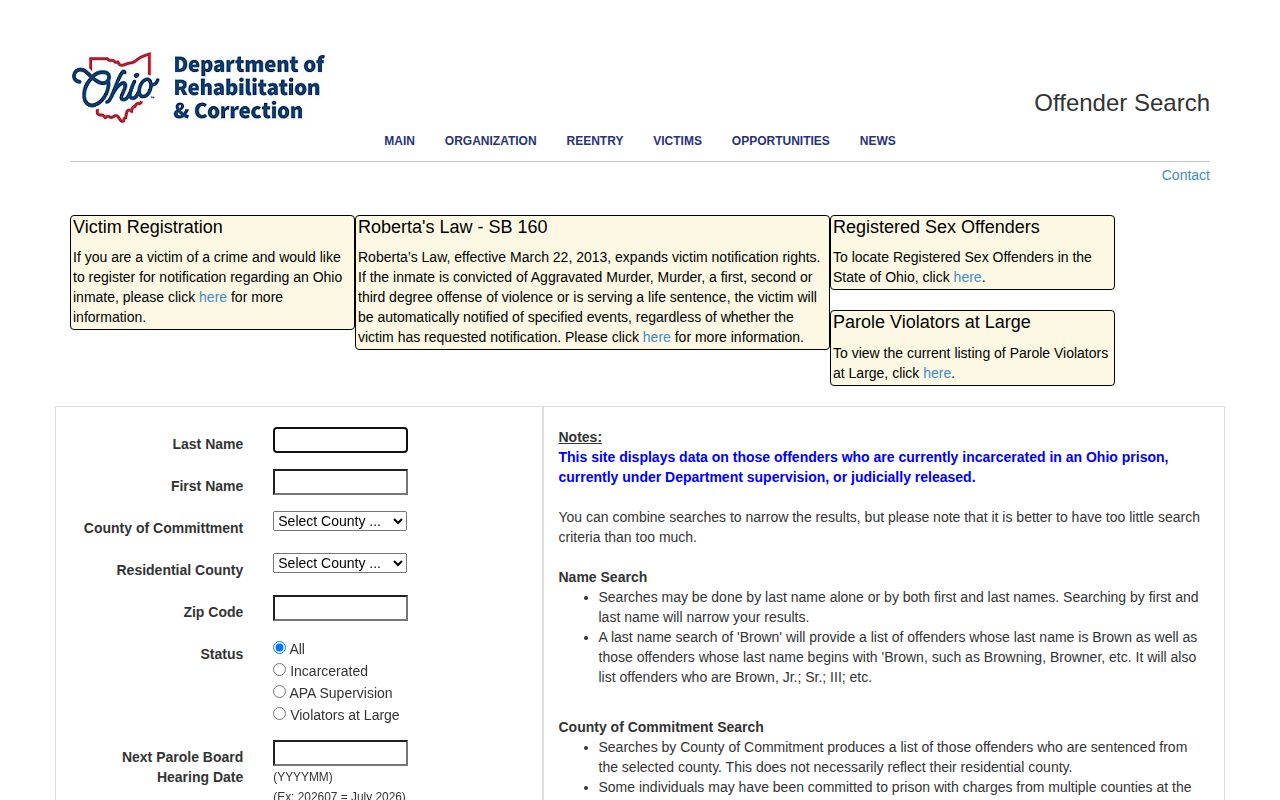
A Brown County commitment should be matched by identity and committing county before its supervision fields are relied upon.
Brown County Probation Office Route
The visible Common Pleas “Probationer Search” is a local trap. Its destination asks for a username and password, so it is not an open public name search. Do not assume that a person is unsupervised because the portal cannot be used. Read the public case docket first, then give the case number to the clerk or probation office for timely confirmation.
The credential-gated probationer portal shows the access limit directly.
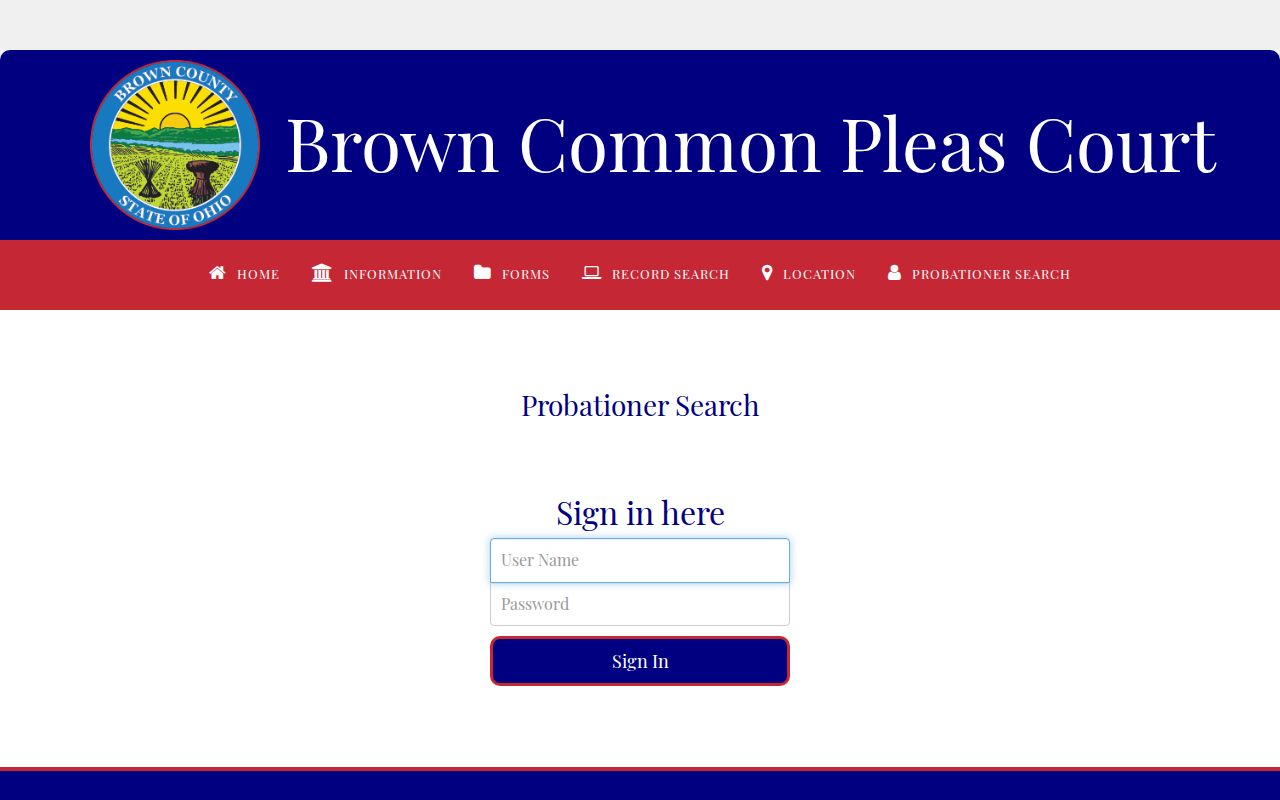
That login screen is evidence of a restricted tool, not a public lookup failure.
Start with the applicable Common Pleas or Municipal Court docket.
Use the case number when contacting the clerk or probation office.
Municipal reporting and testing hours in the local rules: Monday through Friday, 8:00 a.m. to 3:30 p.m.
Municipal local rules say a person referred to community control must meet the probation officer right after sentencing or arrange the first appointment. The listed weekday hours are local procedure. They do not prove that every released Brown County inmate has probation, and they do not apply to state APA cases.
Brown County Absconders and Warrants
An absconder has stopped reporting or otherwise cannot be located by the supervising authority. ODRC uses “Violator at Large” for an APA subject who has absconded. Any address in that record is the last recorded address, not a current known location. The proper response is to read the status exactly and follow official safety instructions.
A Brown County court violation may appear as a motion, violation filing, bench warrant, bond revocation, or later judgment. Municipal rules warn that failure to report or test can result in a bench warrant or bond revocation. Yet an old docket entry may remain visible after a later resolution. Review the full chronology and confirm with the issuing court.
The sheriff's Brown County Most Wanted page is a limited wanted-person channel, not a full probation list. Absence there does not clear a warrant or supervision violation.
Brown County Reentry After Release
Supervision is only one part of release. Brown County's locally hosted Brown-Adams resource guide can help identify leads for health care, food, transport, treatment, and other services. It is dated August 2018, so every program, number, and eligibility rule must be checked again before use. The guide is a starting point, not proof that a service still operates.
For someone leaving the Brown County Jail, release to the community differs from transfer to ODRC, another jail, ICE, or the U.S. Marshals Service. Verify the receiving custodian before planning an appointment. State APA reporting instructions come from ODRC. Court community-control instructions come from the sentencing court.
The Brown-Adams resource guide should therefore be used with direct provider confirmation. A current supervising officer may also explain which services meet a specific supervision condition.
Brown County Release Documents
Identity papers, medicine, personal property, and release instructions should be checked before departure when possible. Brown County Jail information says a remaining inmate account balance is released by check. It also states that when a person is transferred to prison, the jail sends only medical records and required prescription medicine while personal property must be released to another person.
That distinction can affect the first supervision appointment. A prison transfer is not community release, and property held for pickup does not prove discharge from all custody. Keep the jail release paper, court order, ODRC documents, and any probation reporting instruction together. If a document is missing, contact the office that created it.
Ohio Parole Decisions and Release
For an eligible Ohio prison sentence, the ODRC detail record may show the next hearing or review month and the latest Parole Board hearing type and result. A parole recommendation can include a proposed release-on-parole date, often called a POA date. It is not final proof of physical release. Chair review continues, and a decision can change through release day.
Ohio parole eligibility depends on the sentence, offense date, and controlling law. ORC 2967.13 covers eligible life and older indeterminate sentences, while some youth offenses have another route. There is no single eligibility period for all people committed from Brown County.
When a result needs formal proof, request the public minute or order tied to the hearing. Then confirm actual departure through the current ODRC status and Parole/Release Detail. The broader Brown County released inmate search path explains how custody records and court dispositions fit together.
Ending Brown County Supervision
Supervision ends through an official act, not mere passage of time. For APA cases, look for a supervision end date, termination, or release from parole in the ODRC detail and obtain agency confirmation if the entry is unclear. For court probation, find a termination, discharge, expiration, or final judgment in the correct Brown County case.
Ohio public-record law does not make every parole or probation file open. ORC 149.43 starts from public-office records but contains exemptions for protected supervision, law-enforcement, medical, juvenile, and other material. Ask for a defined status record, docket entry, public order, or discharge record. The custodian can redact protected parts and should explain a denial.
Keep county probation and state parole separate to the end. A court discharge closes the court supervision identified in that case. An APA termination closes the state supervision shown by ODRC. Neither record alone settles a different agency's hold.
A clear verification request names the person, case or offender number, the type of supervision, and the date being checked. Ask whether supervision was active on that date and whether the available public record shows termination, discharge, or a pending violation. This narrow approach helps the clerk or agency find the right record without confusing a former jail stay with a later prison or court case. If an office withholds part of a supervision file, ask for the public docket entry, order, minute, or status field that answers the same limited question.
Preserve the source date with any result. Brown County court dockets can post late, while ODRC status can change after a violation or final termination. A saved result describes what the official source reported at that time. A newer official entry controls when the two conflict.