
Brown County Release Meanings
“Released” describes the end of one agency’s custody, but not always a return home. A Brown County Jail discharge may follow bond, time served, dismissal, or a court order. A transport to the Ohio Department of Rehabilitation and Correction, another jail, the U.S. Marshals Service, or immigration custody also removes a name from the county roster. That event is a transfer between custodians. The sheriff’s jail register and discharge-authority papers should identify the recorded event, while the receiving agency’s locator can show where custody continued.
Probation and parole are not forms of confinement. Probation, often called community control in Ohio court records, is imposed by a court. Parole and post-release control are state supervision after prison. A person can therefore be released and still have reporting duties. A “detainer” is a request or hold tied to another authority. It can cause an apparent jail release to lead directly to a new custodian rather than the community.
| Recorded event | What it means | Best next check |
|---|---|---|
| Bond release | Court-authorized release while the case continues | Municipal or Common Pleas docket |
| Time served | The ordered jail term has been credited as complete | Judgment entry and sheriff record |
| Prison transport | County custody ended but state custody began | ODRC Offender Search |
| Community supervision | Custody ended with court or APA conditions | Court docket or ODRC APA status |
| Federal or ICE transfer | Another custodian may now hold the person | BOP, federal docket, or ICE locator |
Brown County Release Record Fields
The county does not publish a historic release list. The durable source is the public portion of the Brown County Sheriff’s records. Its retention schedule identifies the jail register and arrest record as permanent. Commitments and warrants to discharge are retained for two years, daily control logs for five years, released-property records and tags for five years, and several other jail record series for four years. These different periods make a focused request important, especially when the authority to discharge is the key document.
A complete response may vary by what the office maintains and what Ohio law permits. Ask for fields, not a conclusion. The most useful field set ties the booking to the exit event and prevents a transfer from being mislabeled as freedom.
| Field | What it can establish |
|---|---|
| Name and identifiers | Which person the record concerns |
| Booking number and date | The specific custody episode |
| Release date and time | When Brown County custody ended |
| Reason or authority | Bond, court order, sentence completion, or other recorded basis |
| Releasing facility | The custodian that ended its hold |
| Receiving agency or destination | Whether another form of custody followed |
| Associated case number | The court path for disposition details |
The record reports an agency event. It does not, by itself, resolve every court issue or prove that no other hold existed. Compare it with the matching docket and receiving-agency search.
Request Brown County Release Records
The Brown County Sheriff records and retention page publishes the office schedule but no dedicated online request form, email channel, fee chart, office hours, or promised turnaround. The office is at 750 Mt. Orab Pike, Georgetown, Ohio 45121, phone 937-378-4435 and fax 937-378-2039. Call before visiting or faxing. Ask the records custodian which current submission method it accepts.
- Identify the person with a full name and another available identifier.
- Give an approximate booking date so the request points to one custody episode.
- Request the public parts of the jail register or arrest record, including booking and release date and time, release reason or authority, facility, and receiving agency if recorded.
- Ask for the related commitment or warrant to discharge and the booking photograph if maintained and public.
- Request electronic copies and ask for the permitted actual copying cost before production.
Ohio Revised Code 149.43 generally requires public records to be promptly prepared and made available within a reasonable time, subject to exemptions and redaction. Brown County research found no fixed sheriff fee or response time. A narrow request helps the office identify existing records without asking it to perform legal research.
Brown County Sealing Effects
Public access can change after a case is sealed or expunged. Ohio’s current framework in ORC 2953.31 through ORC 2953.34 defines official records broadly and sets different routes based on the offense and disposition. Sealing restricts public inspection to authorized users and purposes. Expungement generally calls for destruction, deletion, or erasure, subject to statutory exceptions.
Eligibility and timing depend on the case. Traffic matters, many violent offenses, registrable sex offenses, specified domestic-violence cases, high-level felonies, and other categories have limits. Dismissals, not-guilty findings, no bills, and pardons also follow their own routes. A missing public result can reflect sealing, expungement, a name mismatch, a posting delay, or a system limit. It is not proof that no arrest, custody episode, or release occurred.
Find Brown County Jail Releases
The Miami Valley Jails Brown County roster is labeled “Persons Currently In Custody.” It is CAPTCHA and session gated, and the provider table states a 30-minute refresh. It is useful for checking whether Brown County Jail still reports a person in custody. It is not a 24-hour, 72-hour, or historic release archive.
- Check the current roster for the exact person and note the provider.
- If the person no longer appears, do not assume a community release.
- Request the sheriff’s release fields and discharge authority.
- Search the correct Brown County court for the case and disposition.
- Use ODRC, BOP, or ICE if the record suggests a transfer.
- Use VINE as a notification layer, then verify with the custodian.
A name that leaves the roster could reflect bond, time served, transfer, a court release, data correction, or another event. The Released Last 24 Hours and Released Last 72 Hours paths therefore lead with the sheriff-record fallback rather than inventing a feed.
Brown County Court Release Proof
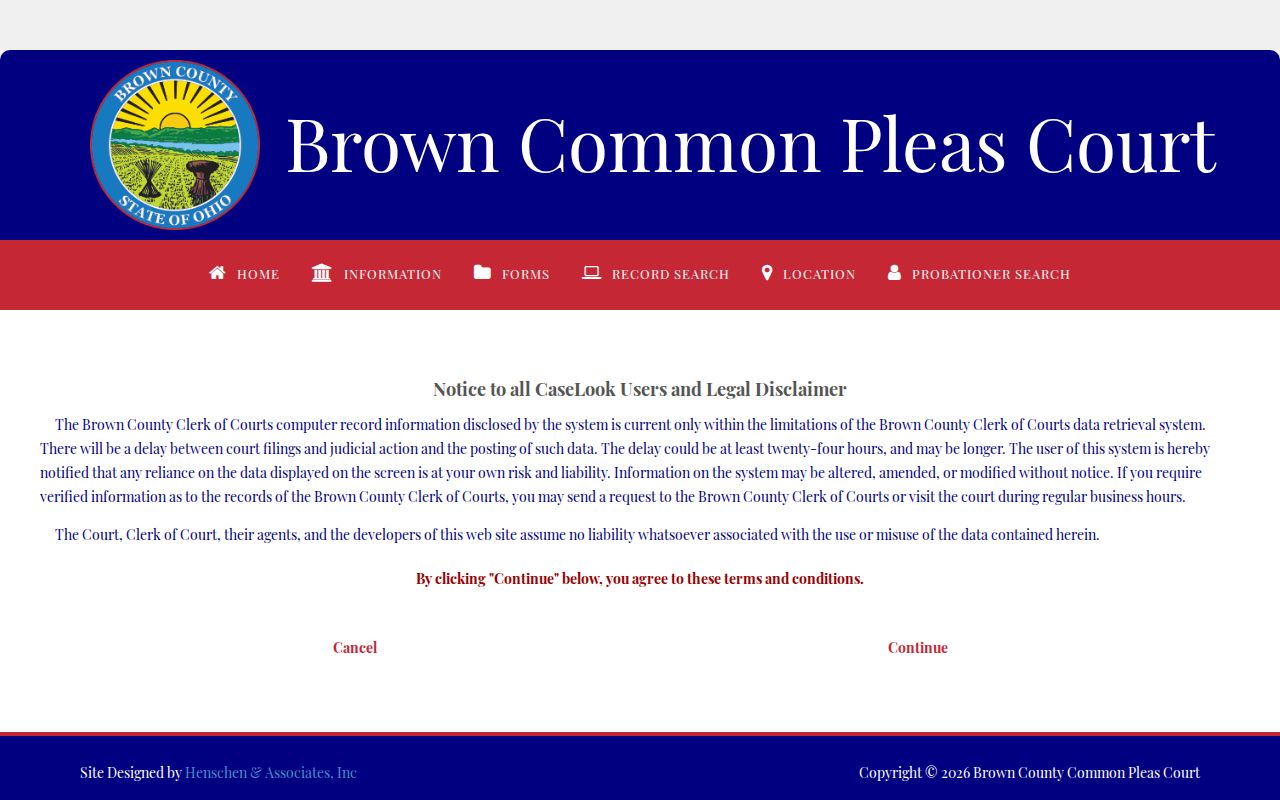
Brown County has separate court searches. The Common Pleas record search is the main route for felony and general-division cases. The Municipal Court search covers misdemeanor and traffic matters and may show early proceedings before a felony transfer. Both warn that online entries can lag at least 24 hours and possibly much longer.
The official Common Pleas screen shows that warning directly.
Use the case number and chronological docket, then obtain a clerk copy when the exact release authority matters. A bond entry may explain a bond release. A judgment can show time served, community control, jail, or prison. A commitment entry can show movement to ODRC. A dismissal or not-guilty result can explain release without conviction.
Municipal Rule 1.06 adds a local detail: an existing bond normally continues through final disposition unless the surety is discharged. With written consent, the clerk may apply cash-bond funds to fines and costs and refund the balance to the poster upon receipt. Bond release is court-authorized and is not the same as sentence completion.
Search Ohio Prison Releases
The ODRC Offender Search applies when a Brown County case led to state-prison custody. It is not a county jail release list. Search options include last name, first name, county of commitment, residential county, zip code, status, and offender number. The number begins with A or R followed by six digits. Status choices include Incarcerated, APA Supervision, Violator at Large, and Released.
The official search screen exposes the statewide status and date fields used for this distinction.
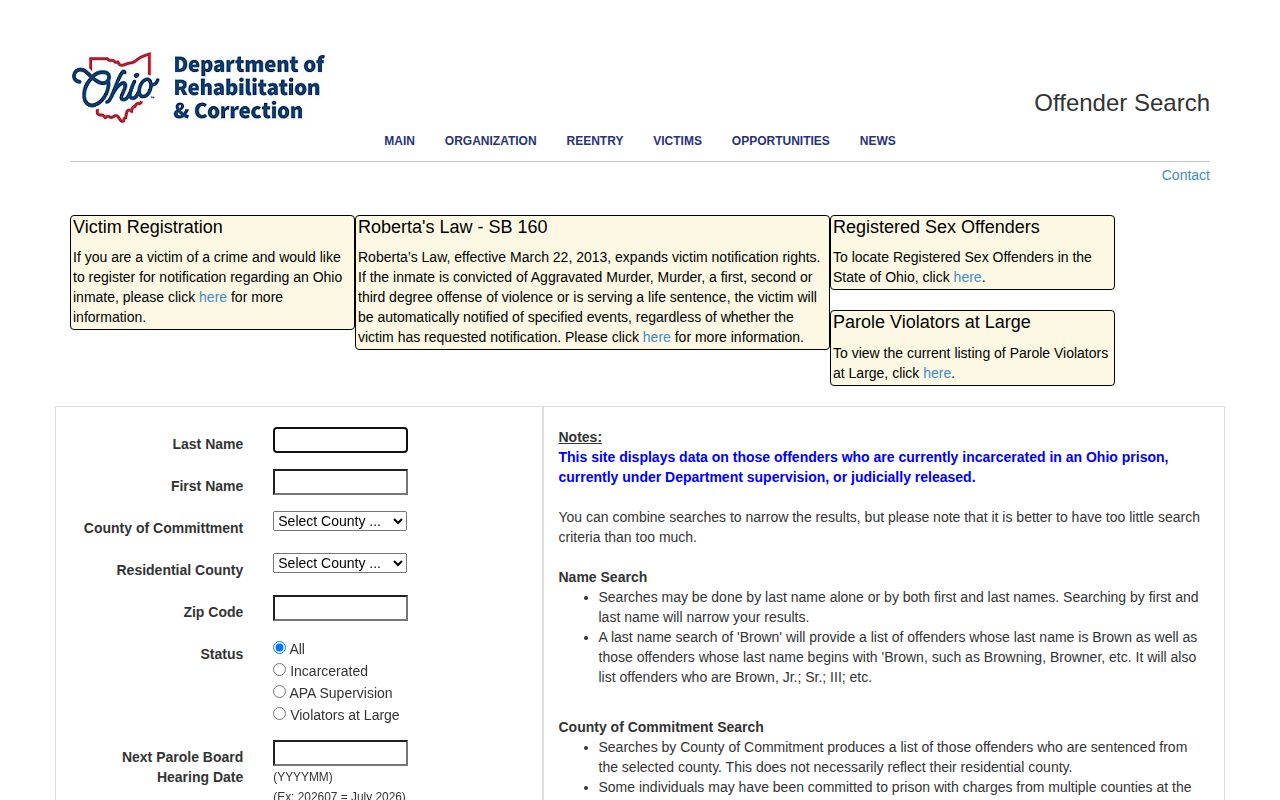
Open the detail record and read Status with Parole/Release Detail. A release entry can show release type, date, and supervision information. The ODRC definitions page warns that dates may be projected, parole eligibility dates, or otherwise subject to change. An incarcerated result and an “Expected Release Date/Parole Eligibility Date” do not establish that release has already occurred.
| ODRC field | Use |
|---|---|
| County of Commitment | Narrow to cases committed from Brown County |
| Status | Separate incarcerated, APA supervision, released, and violator records |
| Offender Number | Distinguish people with similar names |
| Parole/Release Detail | Read the recorded release type, date, and supervision path |
Brown County Supervision Checks
County probation and state supervision must remain separate. A Brown County Common Pleas “Probationer Search” link leads to a username-and-password portal, not an open public name search. Confirm county probation through the relevant court docket and court or probation office. Municipal rules state that a person placed on community control must meet the probation officer right after sentencing or arrange the first appointment.
State parole and post-release control are handled by the Ohio Adult Parole Authority within ODRC. An open ODRC search for Status = APA Supervision can help verify that state layer. The Parole / Probation page separates court community control, APA supervision, and Parole Board records.
Brown County Release Notifications
VINELink provides Ohio custody-event searches and notification registration across county jails, ODRC, and juvenile facilities. A VINE result must be read with its reporting agency. A missing result does not confirm release. A “General Release” event differs from a transfer, escape, or death alert, so the event should be checked against the sheriff or ODRC record.
The VINELink Release Check explains how to search one person, register a phone or email, use the four-digit phone PIN, and confirm the custody change. For safety planning, never rely on VINE alone. Ohio VINE is available at 1-800-770-0192, with TTY at 1-866-847-1298.
Brown County Federal Release Routes
A federal case follows different systems. The BOP Inmate Locator covers federal inmates from 1982 onward and can show a release date with “Released” or “Not in BOP Custody.” That means BOP custody ended, not necessarily that all custody or supervision ended. A federal court docket supplies the detention or release order, while U.S. Probation may hold supervision information.
ICE’s Online Detainee Locator includes current detainees and people released from ICE custody during the prior 60 days. Exact matching and upload delays matter. An ICE detainer can turn a Brown County discharge into immigration custody. The U.S. Marshals Service has no comparable public release locator, so use the federal docket for a pretrial defendant and BOP after designation.
Getting Home After Brown County Release
No current official source establishes jail-provided transportation, a fixed-route stop at the jail, a family waiting area, or a rideshare procedure. A county-hosted Brown-Adams resource guide names eligibility-limited transportation and taxi leads, but the guide was revised in 2018. Treat those entries as old leads that require direct confirmation, not a promise of a ride.
Call ahead when planning pickup. Brown County research did not establish an ordinary release time, exit door, holiday schedule, or waiting location. A person transported to prison is not being released home, so transportation planning must first resolve the recorded destination.
Brown County Release Property
The sheriff’s inmate information says the remaining inmate-account balance is issued at release by check or debit card. Prison transfers follow a stricter property rule. The jail accepts no items for the person to take to prison, destroys tobacco, and requires a family member or friend to collect personal items within five days of transport or the items are destroyed.
The page below records that local account and transfer distinction.
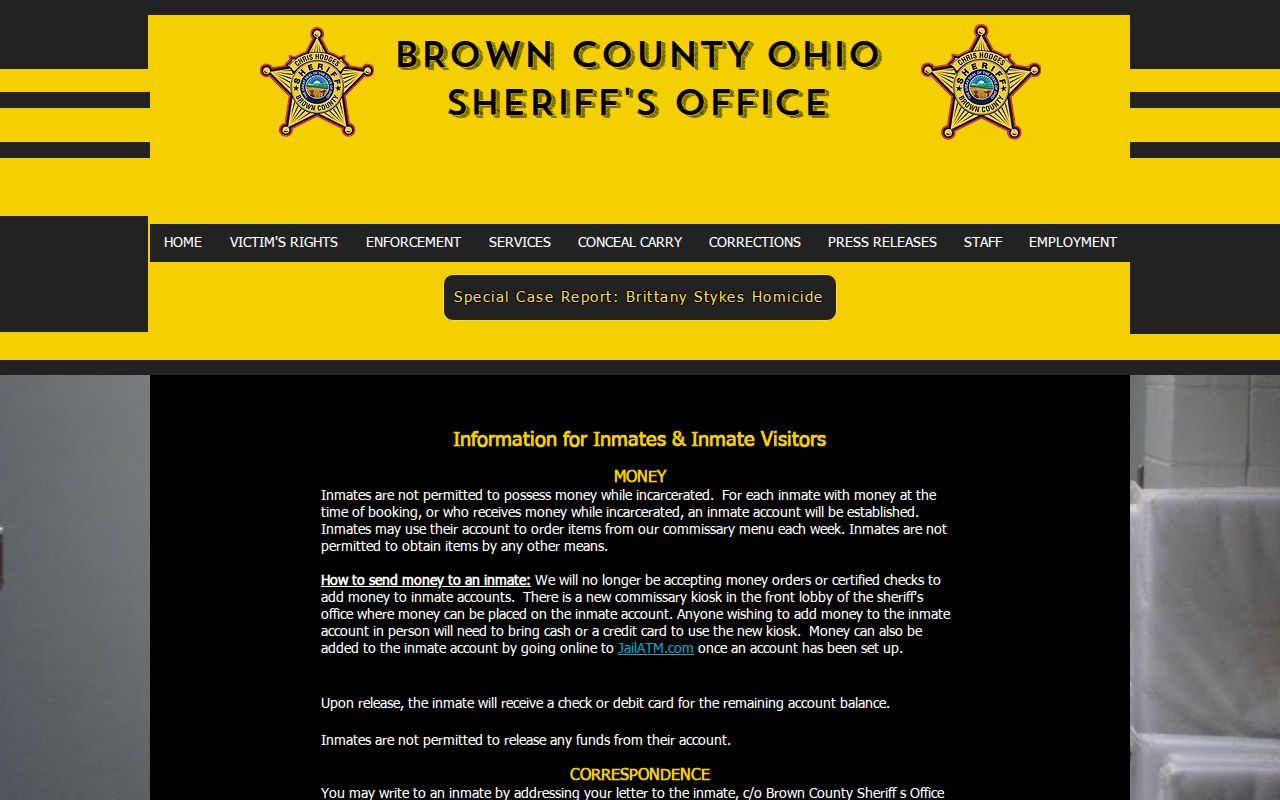
The sheriff’s retention schedule separately keeps released-property records and tags for five years. That series can provide a correction path when the recorded disposition of property is disputed.
Brown County Recovery Leads
A county-hosted Brown-Adams resource guide lists Talbert House Brown County Recovery Services and local recovery meetings as possible starting points after release. The document dates to 2018. Confirm every address, program, schedule, and eligibility rule with the provider before relying on it. Its useful role is limited to identifying local organizations worth calling.
Brown County Custody Comparisons
Each official system answers a different question. The county roster answers whether Brown County Jail currently reports a person. The sheriff’s retained jail records answer what the county recorded about an earlier booking and discharge. Court dockets explain the legal action behind bond, dismissal, sentencing, community control, or prison commitment. ODRC records a person who entered state prison and may later show Released or APA Supervision. BOP and ICE cover their own federal custody systems.
Use a date as well as a name. Similar names can appear in more than one system, and one person can have several custody episodes. Match a booking number, case number, offender number, date of birth, or another available identifier before joining records. A current-custody entry is not a release record. In the same way, an old release date does not rule out a later booking.
| Question | Correct Brown County route | What not to infer |
|---|---|---|
| Is the person in the county jail now? | Miami Valley Jails current roster | No result does not prove community release |
| When did county custody end? | Sheriff jail register and discharge authority | The date alone does not identify the destination |
| Why did the court permit or order release? | Common Pleas or Municipal docket | An online entry may be delayed |
| Did state-prison custody follow? | ODRC Offender Search | County roster disappearance is not a prison discharge |
| Did federal custody end? | BOP locator and federal docket | Not in BOP custody does not end all supervision |
Ohio Release Record Boundaries
Ohio public-record law begins with records kept by public offices, but it has exclusions for protected law-enforcement information, juvenile matters, medical material, and parts of parole or probation files. A custodian may redact protected content and should explain the legal basis. Asking for the public portions of named records keeps a Brown County request precise without assuming that every field must be released.
ODRC has a more specific rule. Under ORC 5120.21, the department keeps entrance, commitment, transfer, discharge date, cause and terms, condition on leaving, and death information. The full inmate and APA file is generally not public. Disclosable categories include a name, convictions, photograph, supervision status, current or past incarceration place, and disciplinary history. OAC 5120-9-49 also identifies qualifying APA and Parole Board determinations, orders, and minutes as public records.
Juvenile and registry limits deserve care. The Brown County sheriff’s registry gateway states that registered juveniles are excluded from the public Ohio registry. A registry is also a narrow statutory tool, not a general released-inmate list. No result there says nothing conclusive about an unrelated arrest or jail release. Always ask what the selected database actually covers before treating absence as evidence.
Brown County Detention Facility
The Facility Map confirms one local detention facility. Brown County Jail, operated by the Brown County Sheriff’s Office, is at 750 Mt. Orab Pike in Georgetown. The jail’s current roster covers people presently held. Release verification comes from the sheriff’s records, the correct court, and any receiving-agency locator.
| Facility | Release path |
|---|---|
| Brown County Jail | Sheriff release record, Common Pleas or Municipal docket, then ODRC/BOP/ICE if transferred |